Sim content diversity v3: spread 3× — bar MISSED — while the guard falls to 0.673, the best top-cam read yet
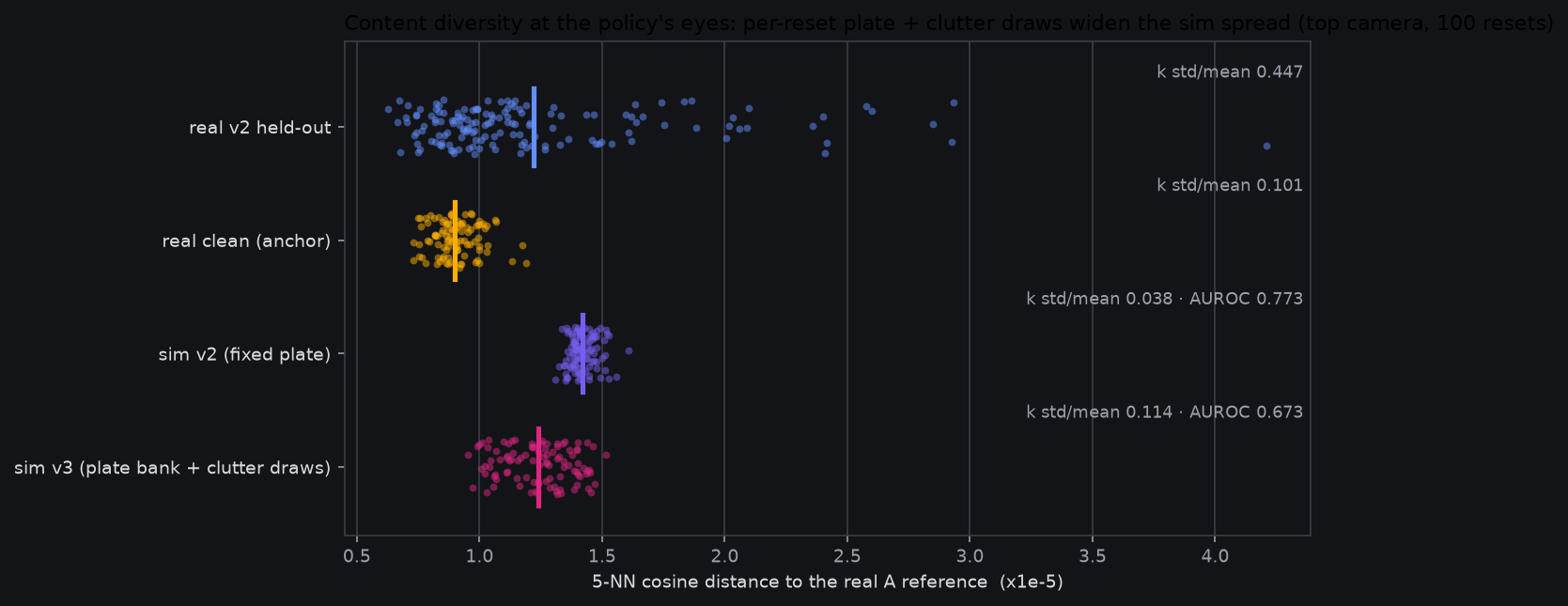
2026-08-12 ~07:2xZ work session (in-channel 07:24:00Z per the Discord timestamp; this stamp and the pre-reg’s were corrected at 07:2xZ — the first draft carried times from an unchecked clock). Executes the content-diversity pre-reg (registered same session, in-channel 06:35:39Z). Verdict up front, both legs: top sim k std/mean 0.038 → 0.114, short of the registered ≥ 0.15 — the bar is MISSED as registered. The AUROC leg of the same bar did not just hold its ≤ 0.790 guard — it fell to 0.673 (v2: 0.773), with k-ratio 1.02× and centroid ratio 0.99×: the top camera’s composites now sit inside the real embedding spread, the strongest top-cam read this axis has ever produced. Per the registered flip rule (bar met = flip), the shipped default stays v2; v3 strictly dominates v2 on every measured number, so the flip is put to the owner as a one-line call.
Plain words
We gave the simulator a deck of 26 real backgrounds — one per real recording, each carrying that recording’s actual daylight — and taught it to scatter the desk clutter (mouse, mug, laptop) the way the real operator actually scattered it between recordings, including leaving things out of the scene at the measured frequencies. Every simulated episode now looks like a different day at the table instead of the same day repeated. We pre-promised two numbers: the spread of the simulator’s frames (as the policy’s own vision encoder sees them) should reach 15% where real recordings sit at 45%, and the frames should get no easier to tell from real. The spread tripled — 4% to 11% — but did not reach 15%, so by our own pre-registered rule this is a miss and the new mode does not ship as the default. The second number is the story though: telling these frames from real got harder (0.773 → 0.673, where 0.5 is “can’t tell”) — the closest the simulator’s main camera has ever been to passing for real. What’s left of the sameness is the part a fixed start-of-episode snapshot can never have: mid-episode motion, human hands reaching into frame.
Registered reads (reset-render probe, 100 seeds; 20×5 sensitivity)
| read | v2 (shipped) | v3 (this item) | registered line |
|---|---|---|---|
| top sim k std/mean (co-primary) | 0.038 | 0.114 (0.114 at 20×5) | ≥ 0.15 → MISS |
| top 5-NN AUROC (co-primary guard) | 0.773 | 0.673 (0.655 at 20×5) | ≤ 0.790 → over-met |
| top k-ratio sim/real | 1.16× | 1.02× | — |
| top centroid ratio | 1.11× | 0.99× | — |
| per-draw mean-k spread (20×5) | 0.005 | 0.025 | record-only |
| wrist (guard) | 0.548 | 0.548 — bit-identical | frames equal → GREEN |
- Wrist guard: v3 wrist frames bit-identical to v2 for the same
(seed, appearance_seed) — asserted on renders
(
fontaine/scripts/sim_v3_wrist_guard.py, 5 pairs) before any read was credited; the probe’s wrist numbers reproduce the periphery-fix close exactly. - Physics oracles green before any read: settled qpos
bit-identical across v0/v1/v2/v3 and across appearance seeds;
spawn stream bit-matches banked sim100; new oracle pins v3
clutter draws physics-inert (
tests/test_sim_appearance.py, 6 green). - Overfit tripwire clear (0.673 ≫ 0.5).
- Record-only breakdown: all 26 plates drawn across the 100 seeds; between-plate mean-k variation is most of the new spread (0.098 of 0.114); by drawn-clutter count, sparse resets sit closest to real (mean k 1.15e-5 at 1 object → 1.41e-5 at 4).
- Iterations: 2 of the registered ≤ 3 used. Iteration 2 composed each drawn plate’s measured episode gain/bias onto the rendered foreground (coherent per-episode lighting) — encoder-null (0.114 / 0.673 vs 0.114 / 0.671), kept for realism. Third confirmation on this axis that the er_60k encoder is invariant to global photometric shifts (v1 lighting jitter ~3%, v2 fixed-plate homogeneity null, now this): content moves it, light does not.
Side by side
REAL | v2 | v3 gallery — the v3 row varies plate lighting and clutter per reset (absences included; the mouse is genuinely gone from 73% of real A episodes). k-distance strips — v3’s cloud shifts onto the real held-out bulk and widens; the remaining real tail (distances 2–4×10⁻⁵) is mid-episode content no reset render can produce.

What landed (ships as render_style="v3", default STAYS v2)
- Plate bank miner (
make_clean_plates.py --bank→assets/real_plates/bank/): 26 per-episode top plates, inlier median vs the per-episode gain/bias-corrected global plate with feathered fallback — the naive median’s baked boat-on-disk, arm rests and operator hands are excluded by construction (channel-MAX deviation; the channel-mean version let the operator’s hand pass and smeared skin into a plate — caught by inspection, first candidate). Fallback fraction 3–23% per plate. - Measured clutter spread (same pass,
bank_manifest.json): camera model verified by a displace-and-recover selfcheck through the sim’s own segmentation renders (0.4 cm mouse / 1.7 cm pcb; per-object centroid-bias calibration — raw analytic error was up to 12 px on flat shapes). Mouse present 27% of A episodes (absolute box ≈ 7×16 cm), the white up-table item the mug stands in for 15%, laptop 77% (drawn as deltas about canonical — its real center is past the frame edge), pcb near-static (kept canonical). Record-only: the real disk wanders 8–29 cm × ±19 cm across episodes — banked as the baseline fact for the out-of-scope disk-position item. render_style="v3": v2 composite + per-reset plate draw + clutter presence/pose draws, all consuming the appearance RNG after every v2-era draw; the wrist render swaps clutter to canonical (data-side, physics never sees it) so the wrist path is v2 bit-identical.- Charts + probe JSONs pushed; guard script; oracle added.
The flip question (owner call) — ANSWERED: flipped
By the registered rule the default stayed v2 — v3 dominates v2 on
every measured axis (spread 3×, AUROC −0.100, both ratios at ~1.0)
and costs nothing at runtime, so the flip went to the owner.
Owner approved in-channel 07:29Z 08-12 (“should we swing to v3
then?”) and the default is now render_style="v3" (one line,
so101_sim.py; oracles + wrist guard re-run green). The sim100
rerun gate now reads GO-with-v3-frames on both cameras (top 0.673 +
wrist 0.548). The spot-check option from the v1 close stands.
Why the spread bar was probably unreachable
Real held-out spread (0.447) is dominated by episode phase: arm sweeps, the boat mid-carry, operator hands — the long right tail in the strip chart. Reset renders sample none of that by construction. The content levers this item registered (plates + clutter) moved reset-frame spread 3× toward the measured ~0.10–0.12 that start-of-episode real frames plausibly occupy; pushing further on this instrument means diversifying phase, not appearance — i.e., probing rollout frames, not reset frames (a different registered read).
Artifacts
- Probe JSONs: v3 primary · 20×5 homogeneity
- Charts: k-distance strips · REAL | v2 | v3 gallery
- Total GPU spend this item: ~0.08 GPU-h of probe/guard reads (gate 0.3); mining and iteration were CPU.